Pattern, Waste and Scale: Paving Bonds That Earn Their Keep
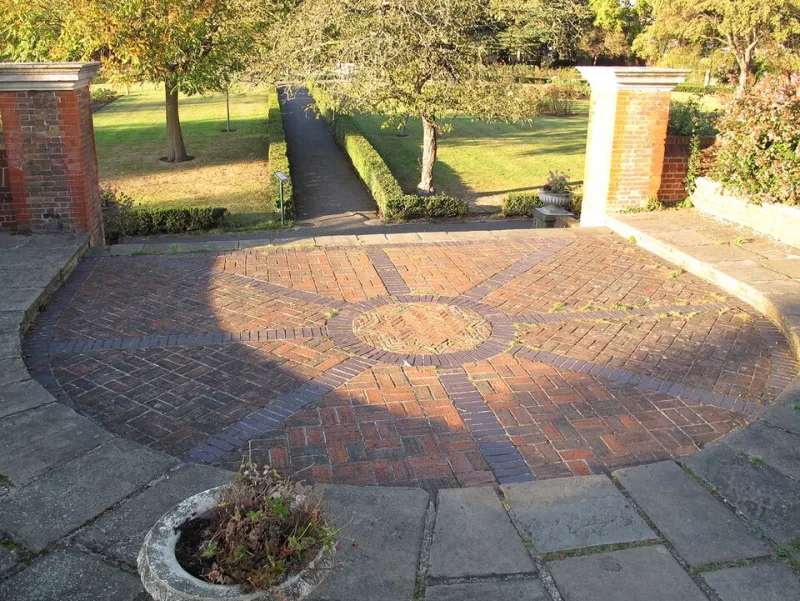
Photo: Stephen Craven , CC BY-SA 2.0, via Wikimedia Commons
Paving patterns are usually sold on looks. That is fair enough, because you have to live with the thing. But a bond is also a structural choice, a waste calculation and a visual decision about scale. Get it wrong and you either spend more than you need to or end up with a patio that looks busy in a space the size of a postage stamp.
In the UK, most domestic paving falls into four families: herringbone, stretcher, stack and basketweave. Each has a place. None is universally right.
Herringbone: the driveway workhorse
Herringbone is the pattern most people recognise from block-paved driveways. Blocks are laid at 45 or 90 degrees in a zigzag, which locks them together and spreads load across the surface. That interlock is why it performs well under cars, especially on a slope or where braking and turning forces are involved.
It is not, however, a free lunch. Herringbone generates more cuts than a simple running bond, particularly around edges and in small areas. A practical allowance is 10 to 15 per cent waste on a decent-sized driveway, and more on a tight courtyard where every edge is a cut. It also needs a compatible block size and a restrained edge, because the pattern relies on being held in place.
On a small patio, herringbone can look frantic. The zigzag draws the eye and makes a modest space feel busier than it is. It can work beautifully on a period terrace path or a driveway, but on a 12-square-metre courtyard with a bistro table, a calmer bond often looks better and costs less in cutting.
Stretcher bond: the quiet default
Stretcher bond, also called running bond, is the workhorse of patios. Rectangular units are laid in rows with the joints offset by half or a third of a unit. It is simple, familiar and forgiving. Waste is usually lower than herringbone, often 5 to 10 per cent, because fewer cuts are needed and offcuts can often be reused.
Structurally, stretcher bond does not interlock in the same way as herringbone, so it relies more on a stable sub-base and a good edge restraint. For a patio that is not taking vehicle traffic, that is rarely a problem. It suits sandstone, concrete slabs and porcelain planks, and it reads as calm rather than clever, which is usually a compliment in a small garden.
A Victorian terraced courtyard with a narrow side return is a good candidate. The space is often long and thin, the eye is already being pulled along it, and a running bond reinforces that without adding visual noise. Use a third-offset rather than a half-offset if the units are long and thin, and keep the joints consistent.
Stack bond: clean lines, rigid base
Stack bond is exactly what it sounds like: units laid in a grid with joints aligned. It gives a crisp, contemporary look and is popular with large-format porcelain. Waste can be very low in the middle of the patio, although edges still need cutting. The catch is structural. Because there is no offset, there is no interlock. Stack bond needs a rigid base, typically a concrete slab or a very well-compacted sub-base with a suitable bedding system, and it is not the right choice for a flexible driveway.
It also shows every imperfection. If the base is not flat, or the units vary in thickness, stack bond will tell the world. It is best reserved for porcelain or precision concrete, laid by someone who understands the bedding system, and kept away from heavy vehicle loads.
Basketweave: period charm, moderate waste
Basketweave uses pairs of blocks laid at right angles to each other, creating a woven effect. It is common in older UK streets and suits clay pavers particularly well. It offers reasonable interlock and a bit of visual texture without the full busyness of herringbone. Waste sits somewhere in the middle, often 8 to 12 per cent, because the pattern needs a consistent module and edges can be fiddly.
It is a good choice for paths, front garden hardstanding and period properties where a plain stretcher bond feels too modern. It is less successful with large-format porcelain, which is simply too big for the basket scale.
What waste really costs
Waste is not just the offcuts in the skip. It is the extra packs you buy, the breakages, the cuts that cannot be reused and the future repairs when a single unit gets damaged. A sensible rule is to order the measured area plus 10 per cent for a simple bond, and 15 per cent for herringbone or any layout with lots of edges, curves or diagonal cuts. Keep the spares. In five years, matching a discontinued colour will be harder than finding a parking space at a garden centre.
Matching the bond to the plot
A narrow side return benefits from a bond that runs with the space, not against it. A small courtyard usually looks better with fewer, larger units and a simple stretcher or stack bond. A driveway that takes two cars needs interlock, so herringbone or a robust basketweave earns its keep. A curved patio edge will generate cuts whatever you choose, so factor that in and avoid patterns that need perfect modules.
Pattern should follow use first, unit size second and taste third. Herringbone is not wrong. It is just not always the answer.