Low Sun, Long Shadows: Paving Choices That Hold Up in British Winter Light
Every paving showroom in the country is lit like a jewellery cabinet. Bright, flat, colour-corrected light bouncing off bone-dry slabs arranged at a comfortable height. It is a lovely place to choose a patio and a terrible place to judge one. The light you will actually live with for the next fifteen years is a low, raking, slightly blue-ish glare that arrives at a shallow angle and disappears behind next door's leylandii by half three.
So before you commit to a pallet, commit to a morning with a sample board. It costs you a few quid in offcuts and one trip to the tip, and it will save you from the specific misery of a patio that looked warm and inviting on a June afternoon and reads as a wet car park in December.
Why the early afternoon matters more than midday
Midday sun, even in November, sits high enough to flatten texture and wash out colour differences. It is forgiving. By two o'clock in the afternoon the sun has dropped to somewhere near 15 to 20 degrees above the horizon across most of the UK, and it is throwing light almost horizontally across your slabs. Every joint becomes a shadow. Every riven edge becomes a black line. Every slight variation in tone gets picked out and magnified.
That is exactly the light you will be looking at through the kitchen window for four or five months of the year. If the paving works at that angle, it will work at any angle. If it only works when the sun is overhead, you have bought a summer-only patio.
Build a board, not a shopping trip
One slab on a trolley is not a sample. It is a colour chip. What you need is something closer to a real installation, at 1:1 scale, with the joint you intend to use.
Get hold of six to nine units — enough to see a repeat, not just one face. Ask the merchant whether you can pull from two different packs or crates, because batch variation is half the story with natural stone and a good chunk of it with concrete block. Lay them on a sheet of ply or a spare pallet, on a slight tilt so it mimics your actual fall (somewhere between 1:60 and 1:80 is typical). Fit the edge restraint detail. Then fill the joints with the jointing material you've actually specified — kiln-dried sand, a two-part resin, whatever it is — because a gappy dry-laid sample lies to you about how the finished thing will read.
If you're weighing up two materials, build two boards. Side by side, in the same light, at the same time. Memory is useless for this. You will convince yourself the buff one was warmer than it was.
The wet test
Once the board is built, get the hose out. Not a light mist — a proper soaking, the sort of wetting that leaves standing water in the joints and a film across the surface. Then look at it again ten minutes later, and again the following morning.
Three things happen when paving gets wet. It darkens, typically by a noticeable notch — dark greys go near-black, buffs go toffee, reds go rusty. It becomes reflective, which means it picks up sky, foliage and whatever is behind it. And it reveals its drainage behaviour, which is where textures start to separate themselves.
A honed or smooth surface sheds water in sheets and looks glassy. A riven or textured surface holds a thin film in the hollows and dries unevenly, which can look patchy for hours after rain stops. Neither is wrong, but you need to know which one you're buying before the pallet lands, not after.
Finishes that tend to fall apart under low winter light
Polished and highly glazed porcelain. Genuinely striking in a brochure. In practice, a low sun at two in the afternoon turns the whole patio into a mirror, and a mirror that shows every footprint, every leaf and every smear of wet grit. It also goes almost black when wet, which is dramatic on a showroom display and slightly oppressive outside a back door in January.
Very dark charcoal, especially smooth concrete. Beautiful when dry. Wet, it soaks up light and reads as a void. It also shows efflorescence and dried rain spots with unusual enthusiasm, and every pale crumb of jointing sand that finds its way onto it.
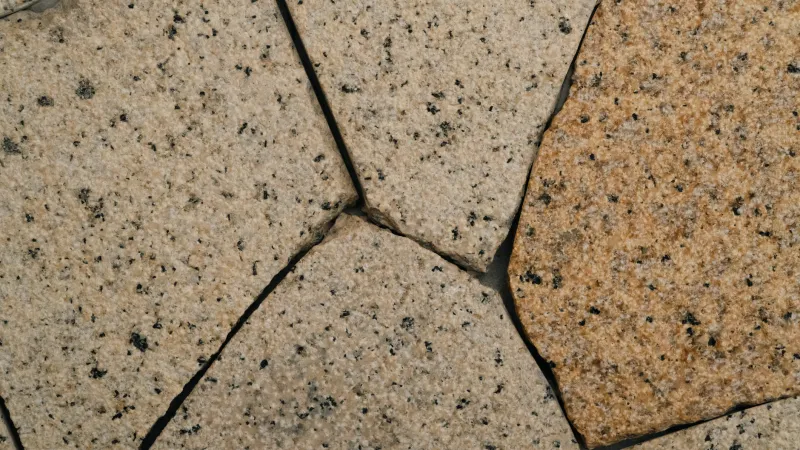
Butt joints and near-zero gaps. Without a shadow line, slab edges disappear and the patio reads as one continuous smeared surface with faint cracks in it. In low raking light this is the most common visual disappointment on new patios, and it is entirely avoidable: a 10–12mm joint gives you the definition that makes the pattern legible.
Heavily riven, high-contrast stone. The low sun does not soften riven texture, it dramatises it. Every ridge casts a shadow roughly four times longer than it would in summer. A stone that looks pleasantly rustic on a dry pallet can look busy and noisy across twenty square metres.
Printed porcelain faces with a strong repeat. A pattern repeat you can't see in a showroom becomes glaringly obvious once shadows and reflections pick out the identical veining every four slabs. If you're going patterned, get enough samples to see two full repeats.
What tends to hold up
Mid-tone materials with restrained variation. Honed or lightly textured surfaces. Warm greys and buffs, which keep some life in them when the cloud comes down. Consistent colour with gentle movement rather than dramatic mottling. And joints wide enough to cast a proper shadow, filled with a material whose colour you've actually looked at next to the slab.
Sawn or finely textured sandstone, good quality concrete block paving laid in a simple bond, and matte porcelain with a subtle stone-effect face all tend to be forgiving in a way that glossy or very dark surfaces are not.
Look from the angles you'll actually use
A sample board on the ground gets judged from above, which is not how you'll see your patio. Take photos from standing height. Look at it through the kitchen window at the time of day you're usually home. Look at it from the back door threshold, sitting on a chair at patio level. If you have a low-voltage garden light, or just a phone torch, see what a warm-white beam does to the colour after dark — because half the year, that's your evening view.
One last thing: ignore your phone camera's judgement. Automatic white balance will quietly neutralise exactly the colour cast you're trying to assess. Use your eyes, and if you must photograph the board, put something neutral in the frame for reference.
A short verdict checklist
Before you sign off on a material, ask yourself: does it still look like a patio at two in the afternoon in November, soaked and reflecting a grey sky? Can I see the bond pattern, or has it blurred into one surface? Does the wet colour still suit the house? Do the joints read as a deliberate detail or a gap? If all four answers are yes, you've done the work most people skip.