The Tree Stays: Paving a Patio Around Mature Roots
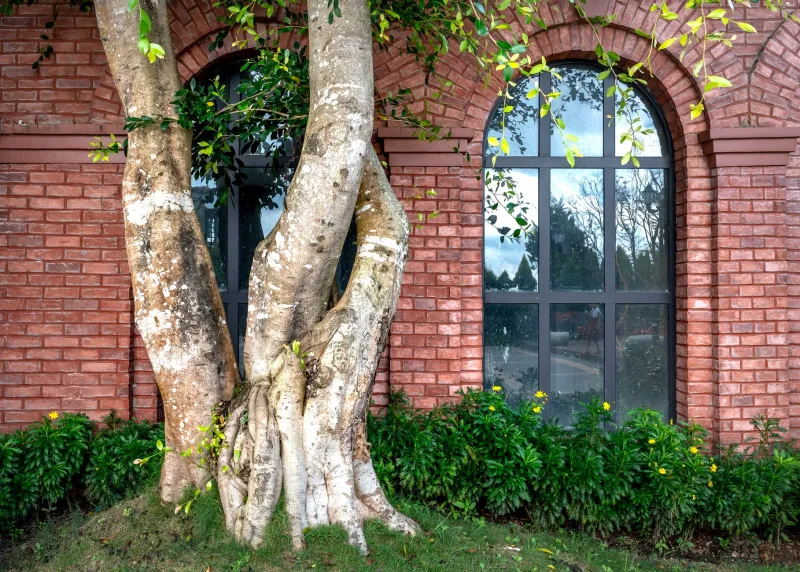
A good tree can add more value to a garden than any paving ever will. It also makes a patio trickier to build. That is not a reason to reach for the chainsaw, and it is not a reason to pretend a standard excavation will be fine. Paving near established trees is a design and construction problem, and it needs solving before the first skip arrives.
Start with the root zone, not the slab
The useful starting point is the root protection area, usually shortened to RPA. In simple terms, it is the patch of ground around a tree that needs protecting if the tree is to stay healthy. For single-stemmed trees, a common rule of thumb is a radius equal to twelve times the trunk diameter measured at 1.5m above ground. On a mature oak or beech, that circle can swallow most of a small garden.
That does not automatically mean the patio is dead in the water. It means the patio has to be designed around that circle rather than laid over it as if the tree were a lamp post. If the proposed paving sits well outside the RPA, you have a normal job with an unusual constraint. If it sits inside, you need a different conversation.
What actually harms roots
Roots are not just big anchors under the trunk. Most of the fine roots that take up water and nutrients are in the top 300mm to 600mm of soil, often spreading well beyond the canopy. They are closer to the surface than many homeowners expect.
The damage usually comes from four directions. Excavation severs roots outright. Compaction squeezes the air out of soil, and roots need air as much as water. Raising or lowering ground levels can smother roots or leave them exposed. And changing drainage can turn a healthy root zone into a bog or a drought, depending on which way the water goes.
That is why a concrete slab on a fresh Type 1 sub-base is such a blunt instrument near a tree. It is not just the slab itself; it is the digging, the machinery, the storage of materials and the compaction that come with it.
Surfaces that ask less of the ground
Where a patio or path must come close to a tree, the aim is a surface that spreads load without deep excavation and lets water through. No-dig cellular systems, permeable block paving on a suitable open-graded sub-base, and gravel or resin-bound surfaces over a cellular confinement layer can all reduce the damage compared with a conventional patio build. None of them is a magic pass. They still need a proper specification and a contractor who understands the difference between “permeable” and “won't compact the root zone”.
An elevated timber deck on screw piles or ground screws is often the cleanest answer. It bridges the roots, keeps the soil undisturbed and can be detailed to let water through the gaps. It is not maintenance-free, and it is not right for every garden, but it is a genuinely useful option when the tree is staying.
For paths, stepping stones set on a shallow, hand-prepared base can work where the route is light-traffic. For a main patio, avoid anything that requires a 150mm dig and a plate compactor inside the RPA.
Design moves that keep both tree and patio
A smaller patio usually solves more problems than a clever detail. Pull the paving back from the trunk, use an L-shape or a pair of separate seating areas, and let the tree sit in a planted or gravel bay rather than in the middle of the slabs. Curves are not just decorative; they can follow the root zone instead of fighting it.
Keep levels as close to existing as possible. If the patio needs to rise, use a shallow build-up or a deck rather than importing 200mm of hardcore over the roots. Edge restraints should be flexible or pinned rather than concreted in deeply. And keep the route for barrows and machinery away from the protected area. A contractor who parks the mixer on the root zone has undone a good specification in ten minutes.
Briefing a contractor properly
Ask for a written method statement that names the tree protection measures. It should cover fencing, hand digging, where materials will be stored, how levels will be kept, and what happens if roots are found. A good contractor will welcome the clarity. A poor one will tell you it is all fine and change the subject.
For anything inside the RPA, involve an arboriculturist. They can confirm the root protection area, assess the tree's condition and write an arboricultural method statement. Root pruning should only ever be done by, or under the direct supervision of, a qualified arboriculturist. It is not a job for a landscaper with a mattock.
Also check whether the tree is covered by a Tree Preservation Order or sits in a conservation area. In the UK, pruning or works within the root zone can need council consent, and “I didn't know” is not a defence. A quick call to the local planning department before work starts is time well spent.
When the honest answer is no
Some trees cannot sensibly be paved around. A mature tree with shallow roots, a trunk close to the house, or a root zone that covers the entire usable garden may leave no sensible patio footprint. If the tree is already stressed, diseased or poorly rooted, adding hard landscaping can tip it over the edge.
In those cases, the options are a deck, a gravel path, a patio in a different part of the garden, or no patio at all. Removing the tree should be the last resort, not the first convenience, and it will often need council permission anyway.
Paving around a mature tree is not a job for a standard template. Get the root zone measured, get the right advice, and choose a surface that lets the tree keep living. The tree stays. The patio fits around it.